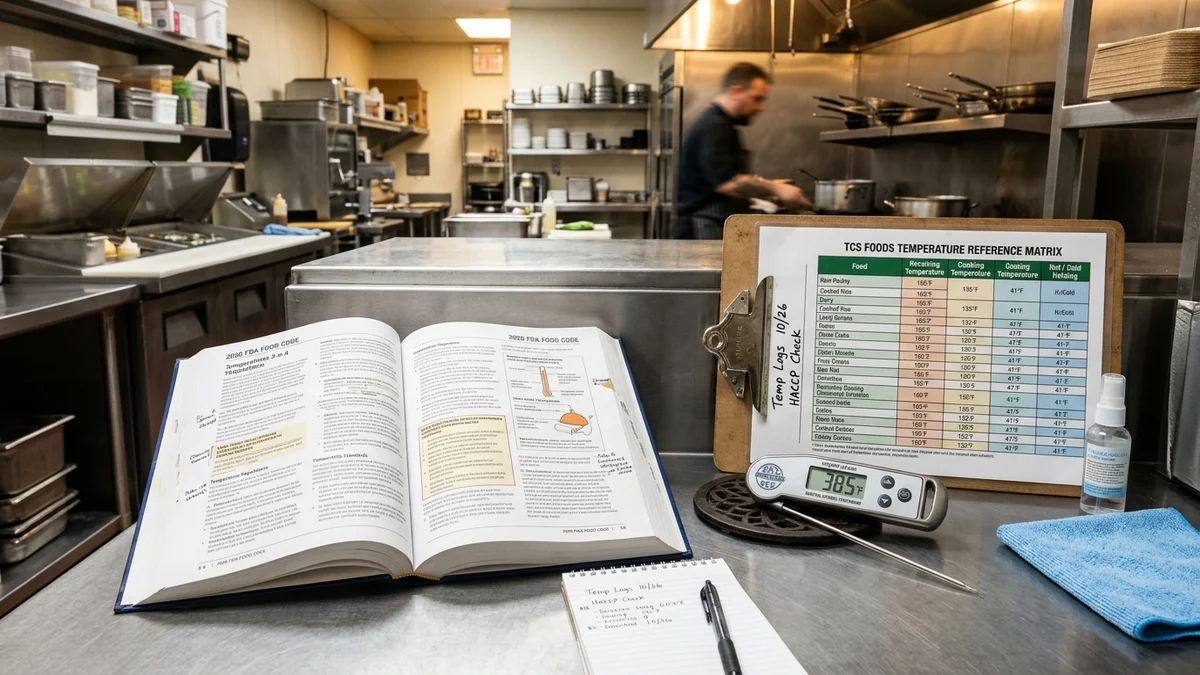
This free ServSafe study guide synthesizes all 10 examination chapters with 2022/2026 FDA Food Code updates, bridging the ServSafe 7th Edition study guide and 8th Edition standards. Master Sesame Big-9 allergen rules, TCS moisture (Aw > 0.85) and acidity (pH > 4.6) thresholds, and export a printable PDF cheat sheet.
ServSafe study guide binder beside commercial kitchen thermometer and FDA Food Code chapter checklist
Interactive 2026 FDA Food Code Workbench
ServSafe® Chapter Explorer & FAT TOM / TCS Food Inspector
2022/2026 FDA Food Code Active (ServSafe 8th Ed. Alignment): Sesame enforced as the 9th Major Food Allergen (FASTER Act), intact beef cook-temp exceptions clarified (145°F for 15s vs. 155°F for mechanically tenderized/injected), and updated Big-6 Norovirus/STEC exclusion protocols active.
Big 6 Pathogens: Norovirus, Nontyphoidal Salmonella, Salmonella Typhi, Shiga toxin-producing E. coli (STEC), Shigella spp., and Hepatitis A. Bacteria double every 20 minutes between 70°F and 125°F.
Core Rule: Big 9: Milk, Eggs, Fish, Crustacean Shellfish, Tree Nuts, Peanuts, Wheat, Soybeans, Sesame
Sesame is the mandatory 9th major allergen under the FASTER Act and 2022/2026 FDA Food Code. Prevent cross-contact with dedicated allergen-free purple equipment, separate fryer oil, and strict ingredient label audits.
Exclude handlers with vomiting or diarrhea until 24 hours symptom-free without medication. Exclude jaundice (≤7 days) or Big 6 diagnoses pending regulatory health department medical clearance. Zero bare-hand contact with RTE food.
Core Rule: Cold TCS ≤41°F; Live Shellfish ≤45°F (cool to ≤41°F in 4h); Shell Eggs ≤45°F air; Hot TCS ≥135°F
Retain live molluscan shellstock tags for 90 calendar days from the date the last shellfish was harvested/sold from the container, organized chronologically. Reject dented seams, bloated cans, or thawing ice crystals.
Ready-to-Eat (RTE) TCS food held >24 hours at ≤41°F must bear a 7-day discard date mark (Day 1 = day prepared or commercial package opened). Store food ≥6 inches (15 cm) off the floor on slatted shelving.
Four approved thawing methods: (1) Refrigeration ≤41°F, (2) Submerge under running potable water ≤70°F for ≤2 hours total in Danger Zone, (3) Microwave only if cooked immediately, (4) As part of continuous cooking.
Core Rule: Cool 135°F→70°F in ≤2h, then 70°F→41°F in ≤4h (6h total). Reheat TCS for hot holding to 165°F (15s) within 2h.
Check holding temperatures at least every 4 hours (every 2 hours allows corrective action). Cold TCS may be held without temp control up to 6 hours if initial ≤41°F and never exceeds 70°F; Hot TCS up to 4 hours if initial ≥135°F.
A regulatory variance and approved HACCP plan are mandatory for Reduced Oxygen Packaging (ROP/Sous Vide), curing/smoking for preservation, sprouting seeds, live molluscan shellfish tanks, or acidifying sushi rice.
Core Rule: Air Gap = 2x pipe diameter (min 1 inch); Foot-candles: 50 Prep, 20 Handwash/Buffet/Cooler, 10 Dry Storage
An air gap is the only completely reliable physical backflow prevention device against cross-connections. Integrated Pest Management (IPM): deny access, deny food/shelter, and partner with a licensed Pest Control Operator (PCO).
5-Step 3-Compartment Sink: (1) Scrape/Pre-rinse, (2) Wash in ≥110°F detergent solution, (3) Rinse in clean water, (4) Sanitize (chemical PPM or ≥171°F for 30s), (5) Air-dry upside down on sanitized drainboard.
Interactive FAT TOM & TCS Food Risk Calculator
Adjust Water Activity (Aw), Acidity (pH), and Holding Temperature to verify whether a food requires Time/Temperature Control for Safety (TCS) under FDA § 1-201.10.
Load Food Sample Preset:
TCS Threshold: Aw > 0.85 supports rapid bacterial growth
TCS Threshold: pH > 4.6 (Neutral to slightly acidic: 4.6–7.5)
"The 2022 FDA rationales matched my actual manager exam questions." — Marcus L.Verified ServSafe Manager(Austin, TX)•
"Scored 89% on my ServSafe exam yesterday!" — Chef Sarah K.Culinary Arts Instructor(Chicago, IL)
ServSafe Study Guide PDF & Printable Cheat Sheet
Culinary students and line supervisors preparing for national certification frequently need a structured, zero-fluff ServSafe study guide PDF that condenses complex regulatory statutes into memorizable kitchen rules. Whether you are reviewing for an entry-level food handler card or preparing to take our 90-question ServSafe Manager practice test simulator, the examination tests applied decision-making across ten standardized chapters rather than rote definitions.
Using the interactive chapter explorer, you can filter every curriculum module by exam weight and click Print / Save PDF Study Sheet to generate a ServSafe study guide printable dossier. Each module maps directly to the 2022/2026 FDA Model Food Code:
Chapters 1–3 (Contamination, Allergens & Personal Hygiene): Focuses on the Big 6 high-consequence pathogens (Norovirus, Salmonella Typhi, Nontyphoidal Salmonella, Shiga toxin-producing E. coli [STEC], Shigella spp., and Hepatitis A), the 20-second handwashing sequence at ≥100°F (38°C), employee symptom exclusions vs. work restrictions, and preventing cross-contact across the Big 9 major food allergens.
Chapters 4–7 (The Flow of Food from Receiving to Reheating): Covers delivery temperature inspection (≤41°F cold TCS, ≤45°F live molluscan shellfish and shell eggs, ≥135°F hot TCS), 90-day shellstock tag retention, the 5-tier top-to-bottom walk-in refrigerator storage hierarchy, 7-day RTE date marking, statutory cooking kill steps, and two-stage cooling curves.
Chapters 8–10 (HACCP Management, Sanitary Facilities & Warewashing): Covers Active Managerial Control, the 7 HACCP principles (detailed further in our advanced ServSafe Manager HACCP study guide), backflow prevention via physical air gaps, minimum kitchen lighting intensity in foot-candles, Integrated Pest Management (IPM), and 3-compartment sink chemical sanitizing concentrations.
ServSafe 7th Edition Study Guide vs. 2022/2026 FDA Food Code Updates
Many hospitality employers still circulate physical copies of the ServSafe 7th Edition study guide or a legacy ServSafe 7th Edition study guide PDF printed before the FDA released its 2022 Food Code supplement. While foundational microbiology and thermal kill steps remain unchanged, candidates relying solely on older ServSafe study guide 7th Edition free notes risk missing four high-frequency 2026 examination updates:
Update 01 · FASTER Act
Sesame Added as the 9th Major Allergen
Older 7th Edition study guides refer to the "Big 8" allergens. Under the federal FASTER Act and 2022/2026 FDA Food Code § 1-201.10, Sesame (found in tahini, hummus, buns, and sesame oil) is mandatory as the 9th Major Food Allergen.
Update 02 · § 3-401.11
Intact vs. Mechanically Tenderized Meat
Whole intact beef/pork steaks require 145°F (63°C) for 15 seconds, whereas mechanically tenderized, blade-tenderized, vacuum-tumbled, or brine-injected meats require 155°F (68°C) for 17 seconds because surface pathogens are driven into the interior.
Update 03 · § 2-301.12
Handwashing Water & Scrubbing Precision
Current exams emphasize wetting hands under clean running water at ≥85°F to 100°F (ServSafe standardizes on 100°F [38°C] for exam testing), scrubbing vigorously with soap for 10–15 seconds, and completing the entire handwashing process in 20 seconds.
Update 04 · § 2-103.11
Mandatory Staff Allergen Awareness
The Person in Charge (PIC) is now explicitly required to ensure that food employees are trained in serious food allergen awareness, including recognizing anaphylaxis symptoms and preventing fryer/utensil cross-contact.
FAT TOM & Time/Temperature Control for Safety (TCS) Parameters
Approximately 30% of graded exam items revolve around controlling bacterial proliferation using the six variables of FAT TOM. In commercial kitchens, food managers cannot easily alter the nutrient composition (Food), ambient Oxygen, inherent Acidity, or internal Moisture of raw ingredients—making Time and Temperature the primary operational controls:
FDA § 1-201.10 TCS Biological Profile (Aw > 0.85 & pH > 4.6): A food is classified as a TCS food when its natural biological profile features a water activity of Aw > 0.85 (typical fresh meats, poultry, cut melons, and cooked grains range from 0.95 to 0.99) combined with a neutral-to-slightly-acidic pH of pH > 4.6. Examples that routinely trip up exam candidates include sliced melons (cantaloupe, watermelon, honeydew), cut tomatoes, cut leafy greens, raw seed sprouts, untreated garlic-in-oil mixtures, baked potatoes wrapped in aluminum foil (an anaerobic environment conducive to Clostridium botulinum), and cooked rice, beans, or pasta.
Vegetative Bacteria vs. Spores & Chemical Toxins (Chapters 1–2): Understanding the microbial difference between vegetative bacterial cells, bacterial spores, viruses, and chemical toxins is heavily weighted. While proper cooking to statutory minimum internal temperatures destroys vegetative bacteria like Salmonella and E. coli, heat-resistant bacterial spores produced by Bacillus cereus (commonly linked to cooked rice and starchy dishes held in the Danger Zone) and Clostridium perfringens (linked to meat stews, gravies, and roasts cooled too slowly) can survive cooking and germinate if two-stage cooling limits are violated. Similarly, histamine (scombroid toxin) in time-temperature abused tuna, mahi-mahi, or bluefish—and ciguatoxin in predatory reef fish such as barracuda, grouper, jacks, and snapper—are heat-stable chemical toxins that cannot be destroyed by cooking or freezing.
Employee Health Restriction vs. Exclusion & 3-Compartment Sinks (Chapters 3, 9 & 10): Candidates must distinguish between Restricting a food handler (reassigning them to non-food duties for a regular sore throat with fever) and Excluding them from the establishment entirely (mandatory for vomiting, diarrhea, jaundice lasting ≤7 days, or any clinical diagnosis of the Big 6 pathogens, plus sore throat with fever when working with a High-Risk Population in hospitals, nursing homes, or preschools). In the dish room, manual 3-compartment sinks must follow the 5-step sequence—scrape/pre-rinse, wash in ≥110°F detergent solution, rinse in clean water, sanitize via chemical PPM (50–99 ppm chlorine, 12.5–25 ppm iodine, or 200–400 ppm quats) or ≥171°F hot water immersion for 30 seconds, and air-dry upside down without towel drying.
Frequently Asked Questions About the ServSafe Study Guide
7th vs. 8th Edition differences, printable PDF formatting, and 2022/2026 FDA Food Code standards.
Can I use a ServSafe 7th Edition study guide for the 2026 exam?
Yes, a ServSafe 7th Edition study guide covers roughly 90% of the core principles, provided you supplement it with the 2022/2026 FDA Food Code updates (ServSafe 8th Edition alignment). Specifically, you must add Sesame as the 9th Major Food Allergen under the FASTER Act, review intact vs. mechanically tenderized meat cooking distinctions, and study updated Big-6 employee illness exclusion rules.
How do I download or print this free ServSafe study guide PDF?
Click the 'Print / Save PDF Study Sheet' button inside the interactive workbench or press Ctrl+P (Cmd+P on Mac) and select 'Save as PDF'. Our stylesheet automatically formats the 10 chapter summaries, thermal kill steps, sanitizer PPM concentrations, and study guide answers onto clean A4/Letter pages.
What are the six conditions of FAT TOM in the ServSafe study guide?
FAT TOM stands for Food (protein/carbohydrate nutrient density), Acidity (pH between 4.6 and 7.5), Temperature (41°F to 135°F Danger Zone, with rapid doubling between 70°F and 125°F), Time (over 4 cumulative hours in the Danger Zone), Oxygen (aerobic vs. anaerobic/ROP environments), and Moisture (water activity Aw above 0.85).
What is the difference between this general ServSafe study guide and the Manager study guide?
This master ServSafe study guide covers all 10 foundational chapters shared across both Food Handler and Food Protection Manager exams, including FAT TOM, the Big 9 allergens, handwashing, storage hierarchy, and cooking temperatures. Candidates preparing specifically for the 90-question supervisory exam should also review our dedicated ServSafe Manager Study Guide for deep-dive HACCP variance and cooling math.
What are the three types of chemical sanitizers and their required PPM ranges?
Under FDA Food Code § 4-501.114, commercial 3-compartment sinks use Chlorine (50–99 ppm at ≥75°F–100°F depending on pH, ≥7 seconds contact), Iodine (12.5–25 ppm at 68°F, ≥30 seconds contact), or Quaternary Ammonium Compounds / Quats (200–400 ppm per manufacturer label at ≥75°F, ≥30 seconds contact).
How long must shellstock identification tags be kept on file?
Restaurants must keep live molluscan shellfish (oysters, clams, mussels, scallops) shellstock tags attached to the delivery container until it is empty, record the date the last shellfish was sold or served, and retain the tags in chronological order for 90 calendar days.