
Health Card Practice Test: Food Worker Simulator
This free health card practice test prepares frontline restaurant workers for state and county food worker exams (including the Southern Nevada Health District SNHD card, Washington State Food Worker Card, California SB 602, Texas DSHS, and Oregon Food Handler Card) across 25 to 40 multiple-choice hygiene, temperature, and cross-contamination questions.
25-Question Food Worker Health Card Exam & State Grace Period Lookup
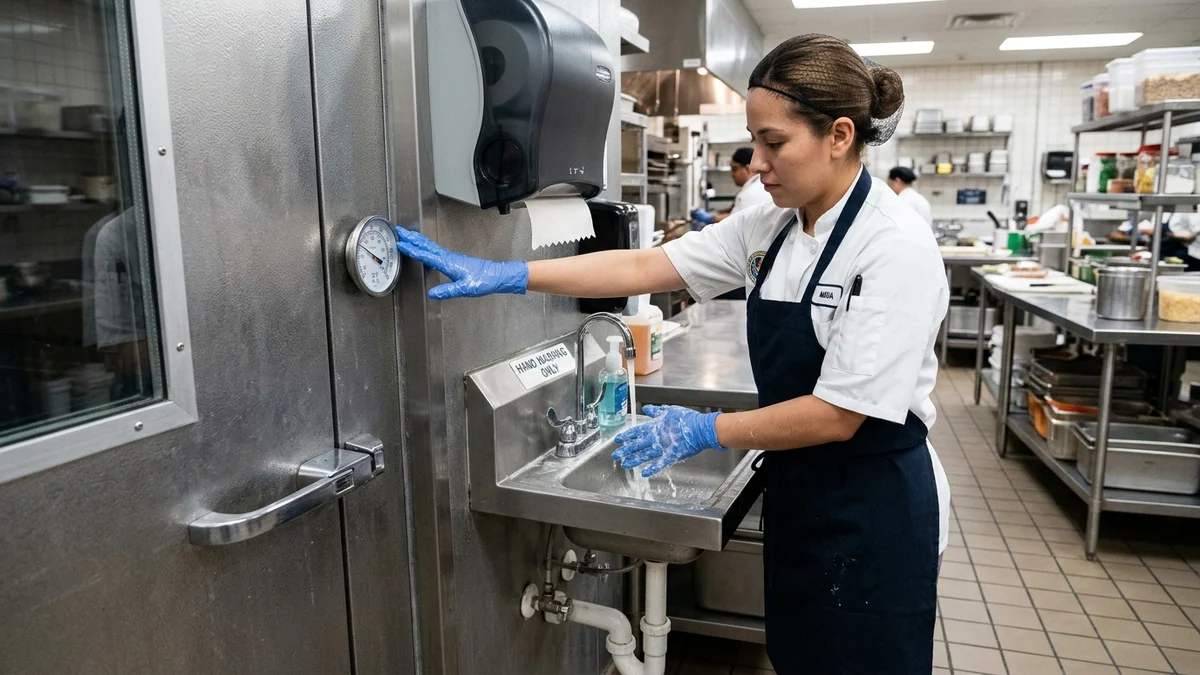
What is the minimum total time required for proper handwashing at a dedicated commercial handwashing sink, including vigorous soap scrubbing?
Under FDA Food Code § 2-301.12, food workers must wash hands for at least 20 seconds total in warm running water (≥100°F / 38°C), scrubbing vigorously with soap for 10 to 15 seconds before rinsing and drying with a single-use paper towel.
Issued exclusively through WA Department of Health / Tacoma-Pierce County portal (doitrightservesafe.com). Generic third-party ANAB cards are NOT accepted in Washington; workers must hold the official WA State Food Worker Card ($10 statutory fee).
State & County Food Worker Health Card Exam Requirements
Across the United States, municipal health departments and state public health agencies require newly hired restaurant cooks, dishwashers, prep staff, baristas, and servers to pass an entry-level food safety examination before or shortly after starting work. Depending on your geographic jurisdiction, this credential is officially called a Food Worker Card (Washington State), a Food Handler Safety Training Card / Health Card (Southern Nevada Health District in Las Vegas and Clark County), a Food Handler Permit (Utah county health departments), or an ANAB-Accredited Food Handler Certificate (California, Texas, Illinois, Arizona, and New Mexico). If your employer specifically requires the 40-question ANAB curriculum, you can also practice on our 40-question ServSafe Food Handler practice test and answer key.
While exam length ranges from 20 to 40 multiple-choice questions and minimum passing thresholds vary between 70% and 80%, every state and county health card exam is derived from the same federal scientific baseline: the 2022/2026 FDA Model Food Code. Local health inspectors design municipal health card tests to verify that every frontline employee can prevent the five primary contributors to foodborne illness outbreaks: poor personal hygiene, bare-hand contact with ready-to-eat foods, improper hot and cold holding temperatures, inadequate cooking temperatures, and cross-contamination between raw animal proteins and ready-to-eat produce. To verify the exact agency portal and statutory fee in your state, consult our 50-state food safety certification and licensing directory.
Core Topics Tested on Municipal Health Department Card Exams
Over 85% of the questions appearing on county health department card exams focus on four daily kitchen habits. Mastering the numerical thresholds below guarantees a passing score on your first attempt:
- 20-Second Handwashing & Eliminating Bare-Hand Contact (§ 2-301.12 & § 3-301.11): Frontline workers must wash hands exclusively at a dedicated handwashing sink (never in a 3-compartment warewashing or food prep sink) using warm running water (≥100°F / 38°C) for at least 20 seconds total, scrubbing vigorously with soap for 10 to 15 seconds before drying with a single-use paper towel. Hand antiseptics (hand sanitizers) may never replace handwashing. Furthermore, bare-hand contact with ready-to-eat (RTE) food—such as salad greens, sliced bread, burger buns, or lemon wedges—is strictly prohibited; workers must use single-use disposable gloves, tongs, deli tissue, or spatulas.
- Temperature Danger Zone & Statutory Cooking Thresholds (§ 3-401.11 & § 3-501.16): The FDA Temperature Danger Zone spans 41°F to 135°F (5°C to 57°C), with rapid bacterial doubling occurring between 70°F and 125°F. Cold TCS foods must be held at 41°F or lower, and hot TCS foods must be held at 135°F or higher. Memorize the four cooking tiers: 165°F for all poultry and stuffed meats; 155°F for ground beef, pork sausage, and mechanically tenderized meats; 145°F for intact steaks, chops, seafood, and shell eggs for immediate service; and 135°F for cooked vegetables, rice, and beans held hot. Review full probe calibration rules in our FDA cooking temperatures and cooling reference chart.
- Walk-In Cooler Shelf Order & Allergen Cross-Contact Prevention: Inside a refrigerator, foods must be stored top-to-bottom by minimum internal cooking temperature: Ready-to-Eat (RTE) foods on the top shelf, followed by whole seafood/intact steaks (145°F), ground meats (155°F), and raw whole or ground poultry (165°F) on the very bottom shelf. Frontline servers and bartenders must also prevent cross-contact involving the Big 9 allergens (Milk, Eggs, Fish, Crustacean Shellfish, Tree Nuts, Peanuts, Wheat, Soy, and Sesame), a topic also tested on our ServSafe Alcohol and front-of-house allergen practice test.
- Employee Illness Reporting & 3-Compartment Sink Warewashing: Food workers must immediately notify the Person in Charge if they experience vomiting, diarrhea, jaundice, or sore throat with fever, and must remain excluded for at least 24 hours symptom-free after vomiting or diarrhea resolves. In the dish pit, manual warewashing follows five mandatory steps: (1) Scrape/pre-rinse, (2) Wash in hot detergent solution (≥110°F), (3) Rinse in clean water, (4) Sanitize via chemical immersion (50–99 ppm chlorine for ≥7s, 12.5–25 ppm iodine for ≥30s, or Quats per label for ≥30s) or 171°F hot water for ≥30s, and (5) Air dry completely.
State Grace Periods, Passing Scores & ANAB Reciprocity Table
Before registering for a commercial course, verify whether your state or county accepts national ANAB-accredited food handler certificates or mandates a government-administered portal exam. For a complete chapter-by-chapter breakdown of biological hazards and FAT TOM conditions, consult our 2026 ServSafe study guide and TCS food safety matrix.
| State / County Jurisdiction | Official Credential Name | Hire Grace Period | Exam Length & Passing Score | Card Validity & ANAB Reciprocity |
|---|---|---|---|---|
| Washington State (WA DOH) | WA State Food Worker Card | 14 Calendar Days | 35 Questions · 80% Pass (28/35) | 2 years initial (3–5 yr renewal). Must use official WA DOH / Tacoma-Pierce County portal ($10 fee); external ANAB cards not accepted. |
| Southern Nevada (SNHD / Clark County) | Food Handler Safety Training Card (Health Card) | Prior to Working | 20–25 Questions · 80% Pass | 3 years validity. Issued directly by Southern Nevada Health District (SNHD) with in-person verification in Las Vegas metropolitan area. |
| California (SB 602 / SB 476) | California Food Handler Card | 30 Calendar Days | 40 Questions · 70% Pass (28/40) | 3 years validity. Accepts any ANAB-accredited provider statewide (employer must compensate training time and fee under SB 476). |
| Texas (TX DSHS) | Texas Food Handler Certificate | 60 Calendar Days | 40 Questions · 75% Pass (30/40) | 2 years validity. Accepts all TX DSHS-licensed and ANAB-accredited food handler programs statewide. |
| Oregon (OHA) | Oregon Food Handler Card | 30 Calendar Days | 35 Questions · 75% Pass (27/35) | 3 years validity. Requires Oregon Health Authority (OHA) approved curriculum ($10 statutory maximum fee). |
| Illinois (IDPH) | Illinois Food Handler Certificate | 30 Calendar Days | 40 Questions · 75% Pass (30/40) | 3 years validity. Accepts ANAB-accredited food handler training programs across all Illinois counties. |
| Arizona (Maricopa, Pima, County Depts) | Arizona Food Handler Card | 30 Calendar Days | 35–40 Questions · 75% Pass | 3 years validity. State law requires all Arizona counties to accept any ANAB-accredited food handler card. |
| Utah (County Health Depts) | Utah Food Handler Permit | 14d Training / 30d Permit | 40 Questions · 75% Pass (30/40) | 3 years validity. Complete state-approved training within 14 days to receive county health department permit within 30 days. |
Health Card vs. Certified Food Protection Manager Credentials
Frontline workers frequently ask whether a county food worker health card satisfies the state health department requirement for a Person in Charge (PIC) or kitchen manager. Under FDA Food Code § 2-102.12, at least one employee with supervisory and management responsibility must hold an ANAB/CFP-accredited Certified Food Protection Manager (CFPM) credential—which requires passing a proctored 90-question exam valid for up to 5 years.
While a Food Worker Health Card qualifies line cooks, prep cooks, bussers, and servers for routine food handling, advancing to shift lead, sous chef, or general manager requires completing the supervisory exam. You can test both levels anytime on our master ServSafe practice exam simulator.
Next Steps for Food Worker & ServSafe Certification
- Take the full 40-question ANAB ServSafe Food Handler practice test with timed and untimed modes.
- Check your state's official portal, fees, and ANAB rules in our 50-state food handler and manager licensing guide.
- Review cooking, cooling, and sanitizer rules on our 2022 FDA Food Code minimum temperatures chart.
- Study all five exam domains in our free 2026 ServSafe study guide and TCS food reference.
- Prepare for front-of-house bar and server compliance with our ServSafe Alcohol and Big-9 allergen practice test.
- Return to the FoodSafetyPrep.online master exam simulator for mixed diagnostic practice.
Frequently Asked Questions About the Food Worker Health Card Test
State grace periods, passing scores, and municipal health department reciprocity rules.
Is a Food Worker Health Card the same as a Food Handler Card?
Yes. Depending on your state or county health department, the entry-level permit required for cooks, servers, bartenders, and bussers is called a Food Worker Card (Washington State), a Health Card or Food Handler Safety Training Card (Southern Nevada Health District / Clark County), a Food Handler Permit (Utah), or a Food Handler Certificate (California, Texas, Illinois, and Oregon).
How many questions are on the local health department food worker card test?
Municipal and state health card exams contain between 20 and 40 multiple-choice questions depending on the jurisdiction. For example, Southern Nevada Health District (SNHD) tests 20–25 questions (80% passing mark), Washington State tests 35 questions (80% passing mark), Oregon tests 35 questions (75% passing mark), and ANAB-accredited ServSafe Food Handler exams test 40 questions (75% passing mark).
How many days after being hired do I have to get my food worker health card?
Statutory grace periods vary by state: Washington State grants 14 calendar days from hire; California, Oregon, Illinois, Arizona, and Utah grant 30 calendar days from hire; Texas grants 60 calendar days; and Clark County / Southern Nevada requires obtaining your health card prior to starting work in a food establishment.
Are ANAB-accredited online food handler cards accepted in every state?
Most states with mandatory food handler laws (including California, Texas, Illinois, Arizona, New Mexico, and Florida) accept any ANSI National Accreditation Board (ANAB) accredited food handler certificate. However, Washington State, Oregon, and specific municipal counties (like Southern Nevada Health District or Riverside County, CA) require tests issued directly through their own state or county portal.
Can I print this health card practice test and answer key as a study sheet?
Yes. Click the 'Print / Save PDF Study Sheet' button inside the interactive stage to print our high-contrast summary sheet and state grace period table for employee onboarding.