
Food Safety Temperatures & Cooking Chart (2022 FDA Food Code)

The 2022 FDA Model Food Code establishes precise thermal kill steps to eliminate vegetative foodborne pathogens including Salmonella enterica, Shiga toxin-producing Escherichia coli (STEC), Campylobacter jejuni, and Listeria monocytogenes. This authoritative reference guide details mandatory internal cooking temperatures, Temperature Danger Zone biological dynamics, two-stage cooling mandates, and holding parameters for commercial food operations.
FDA Temperature Danger Zone & Thermal Inactivation Matrix
Bacterial pathogens proliferate exponentially between 41°F and 135°F (5°C to 57°C), with maximum doubling rates between 70°F and 125°F (21°C to 52°C). Drag the thermal slider or select statutory presets to inspect biological proliferation rates and mandatory kill steps.
FDA Food Code 2022 Statutory Minimum Internal Cooking Temperatures
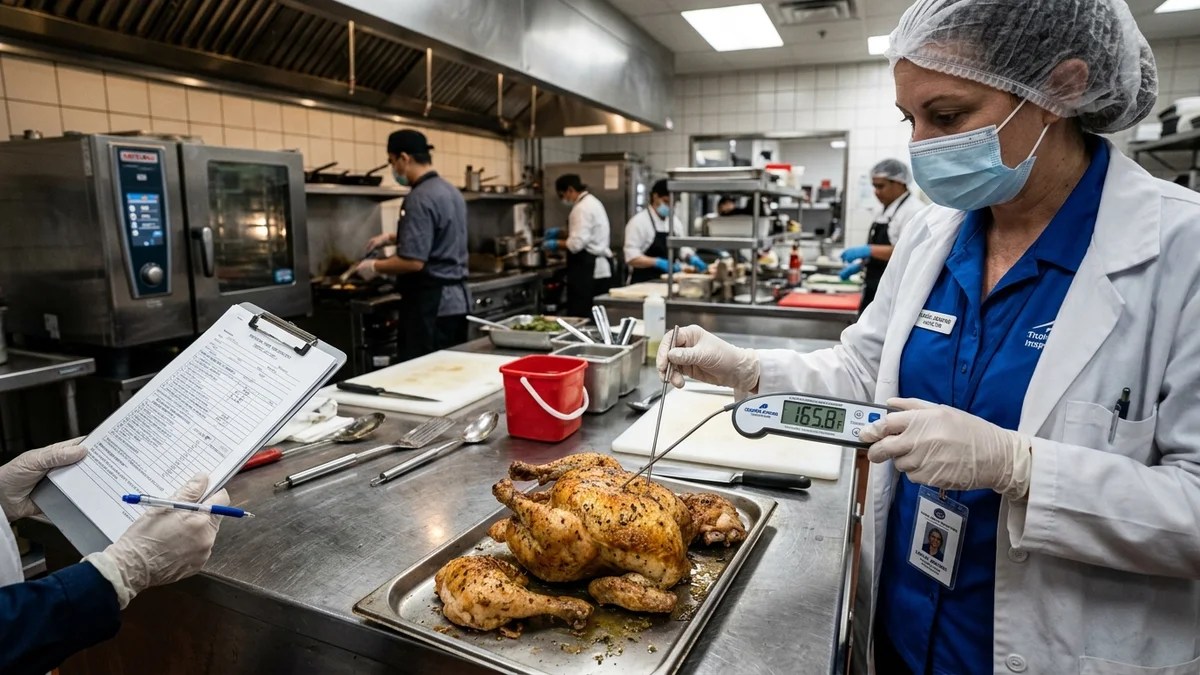
Thermal lethality in raw animal proteins is governed by a relationship between internal temperature and dwell time. Commercial food managers must enforce internal cooking thresholds using a calibrated thermocouple or thermistor probe inserted into the thickest part of the food item.
| Minimum Internal Temp | Dwell Time | Food Categories & Animal Proteins | Primary Target Pathogen | FDA Section |
|---|---|---|---|---|
| 165°F (74°C) | Instantaneous (< 1 second) | Poultry & Stuffed Foods: Whole or ground poultry, stuffed meats, pasta with meat/cheese stuffing, stuffing containing fish/meat/poultry | Salmonella spp., Campylobacter jejuni | FDA Food Code 2022 § 3-401.11(A)(3) |
| 155°F (68°C) | 17 seconds | Ground Meats & Injected Meats: Ground beef, ground pork, comminuted fish, mechanically tenderized meats, injected meats, commercially raised game animals | Shiga toxin-producing E. coli (STEC), Salmonella | FDA Food Code 2022 § 3-401.11(A)(2) |
| 145°F (63°C) | 15 seconds | Whole Seafood, Steaks & Pork Chops: Fish fillets, shell eggs for immediate service, intact beef steaks, veal, lamb, pork chops and roasts | Trichinella spiralis, Anisakis, Vibrio vulnificus | FDA Food Code 2022 § 3-401.11(A)(1)(a) |
| 145°F (63°C) | 4 minutes | Whole Roasts (Alternative Chart): Whole beef roasts, corned beef, pork roasts, lamb roasts (conventional oven: minimum 250°F / 121°C) | Clostridium perfringens, Salmonella | FDA Food Code 2022 § 3-401.11(B) |
| 135°F (57°C) | Continuous holding | Hot Holding Standard: All cooked TCS foods held on buffets, steam tables, or warming cabinets prior to service | Bacillus cereus, Clostridium perfringens | FDA Food Code 2022 § 3-501.16(A)(1) |
| 41°F (5°C) | Continuous holding | Cold Holding Standard: All refrigerated TCS foods (dairy, raw meats, cut melons, cut leafy greens, fresh salsa) | Listeria monocytogenes, Staphylococcus aureus | FDA Food Code 2022 § 3-501.16(A)(2) |
| 135°F (57°C) | Instantaneous | Commercial Plant Foods: Fruits, vegetables, grains, and legumes cooked for hot holding | Spore-forming vegetative bacteria | FDA Food Code 2022 § 3-401.11(C) |
| 165°F (74°C) | Stand 2 minutes covered | Microwave Cooking: Raw animal foods cooked in a microwave oven (must be rotated/stirred, covered, and held for 2 minutes after cooking) | Uneven heating survival prevention | FDA Food Code 2022 § 3-401.12 |
| 165°F (74°C) | 15 seconds within 2 hours | Reheating for Hot Holding: Previously cooked TCS food reheated for hot holding (must reach 165°F within 2 hours) | Spore-forming bacteria outgrowth | FDA Food Code 2022 § 3-403.11 |
What is the FDA Temperature Danger Zone?
Under the FDA Food Code 2022 (§ 3-501.16), the Temperature Danger Zone is 41°F to 135°F (5°C to 57°C). Within this range, pathogenic bacteria multiply rapidly. The most hazardous sub-range is 70°F to 125°F (21°C to 52°C), where bacteria double every 20 minutes. Time-temperature control for safety (TCS) foods left in the Danger Zone for more than 4 hours cumulative must be immediately discarded.
Commercial Walk-In Cooler 5-Shelf Storage Hierarchy
Food in walk-in coolers must be stored from top to bottom in order of increasing minimum internal cooking temperature. Juices from higher-cooking-temperature foods must never drip onto foods requiring lower or no cooking.
Ready-To-Eat Foods
Two-Stage Food Cooling Curve Protocol (§ 3-501.14)
Improper cooling of cooked Time-Temperature Control for Safety (TCS) foods is the leading behavioral cause of commercial foodborne illness outbreaks linked to spore-forming bacteria such as Clostridium perfringens and Bacillus cereus. Because heat-tolerant bacterial spores survive the initial cooking step, rapid cooling is required to prevent germination and explosive vegetative growth.
135°F → 70°F (57°C → 21°C)
The food item must pass through the hyper-proliferation zone (125°F–70°F) in 2 hours or less. If the internal reading does not reach 70°F within 2 hours, the food must either be reheated to 165°F (74°C) for 15 seconds within 2 hours, or immediately discarded.
70°F → 41°F (21°C → 5°C)
The food item must chill from 70°F to cold holding threshold (41°F or below) within an additional 4 hours. The total cumulative time across both stages must never exceed 6.0 hours.
Two-Stage Cooling Process Compliance Auditor
Cooked TCS food must be cooled from 135°F to 70°F within 2 hours, and from 70°F to 41°F or less within an additional 4 hours (6 hours total cumulative time).
Proceed to Stage 2 cooling. Food must reach 41°F within the remaining 4 hours. Use stainless steel shallow pans (< 2 inches deep) or ice bath stirring.
3-Compartment Sink Sanitizer Dilution Calculator
Calculate exact chemical sanitizer ratios, minimum water temperatures, and immersion contact dwell times to achieve mandatory ppm thresholds for 3-compartment dishwashing sinks.
Thermometer Calibration Protocols: Ice Point vs. Boiling Point
Under FDA Food Code § 4-203.11, food temperature measuring devices must be accurate to ±2°F (±1°C) for temperature-measuring devices scaled in Fahrenheit. Commercial food handlers must calibrate stem thermometers daily, after physical shock, or after extreme temperature swings using one of two approved methods:
1. Ice Point Calibration Method (Recommended)
- Fill a clean, insulated cup completely with crushed ice.
- Add clean tap water until the spaces between ice are filled, leaving ice submerged (50/50 slush consistency).
- Submerge the thermometer sensing stem at least 2 inches past the indicator dimple without touching the bottom or sides of the container.
- Hold for 30 seconds until the readout stabilizes.
- While submerged, turn the calibration nut beneath the dial head until the needle reads exactly 32°F (0°C).
2. Boiling Point Calibration Method
- Bring clean potable water to a rolling, turbulent boil in a deep pot.
- Submerge the thermometer sensing stem at least 2 inches into boiling water without contacting the bottom or sidewalls.
- Allow reading to stabilize for 30 seconds.
- Adjust the hex nut until the gauge indicates 212°F (100°C) at sea level.
- Altitude Adjustment Note: Subtract 1°F for every 550 feet of elevation above sea level (e.g., 202°F at 5,000 feet).
Internal Cooking Limits
- 165°F (74°C) Instant: Poultry, stuffing, reheated TCS, microwaved foods
- 155°F (68°C) 17s: Ground beef/pork, mechanically tenderized meat, pooled eggs
- 145°F (63°C) 15s: Seafood, whole steaks, pork chops, single-order eggs
- 145°F (63°C) 4 min: Beef/pork roasts (slow conduction)
- 135°F (57°C) Instant: Plant foods, commercial ready-to-eat hot holding
Critical Storage & Cooling
- Danger Zone: 41°F–135°F (5°C–57°C) | Hyper-Growth: 70°F–125°F
- Cooling Stage 1: 135°F → 70°F within 2.0 hours (Mandatory)
- Cooling Stage 2: 70°F → ≤41°F within 4.0 hours (Max 6h total)
- Walk-In Shelving: Shelf 1: RTE | Shelf 2: Fish/Eggs (145°) | Shelf 3: Roasts | Shelf 4: Ground (155°) | Shelf 5: Poultry (165°)
- Cold Holding: ≤41°F (5°C) | Hot Holding: ≥135°F (57°C)
Sanitizer PPM & Wash
- Chlorine: 50–99 ppm | ≥75°F (24°C) | ≥7s contact
- Quats (QAC): 200 ppm | ≥75°F (24°C) | ≥30s contact
- Iodine: 12.5–25 ppm | ≥68°F (20°C) | ≥30s contact
- Handwashing: 20 seconds total (10–15s vigorous lather)
- Big 9 Allergens: Sesame, Milk, Eggs, Peanuts, Tree Nuts, Fish, Shellfish, Wheat, Soy
Related Food Safety Examination & Prep Silos
- Test your diagnostic knowledge with 90 scenario questions on our ServSafe Manager practice test.
- Review employee hand hygiene and storage rules on our ServSafe food handler practice exam.
- Explore top missed examination questions with detailed FDA rationales on our ServSafe questions and answers guide.
- Verify state-by-state ANSI-CFP certification compliance rules in our state food handler requirements directory.
Frequently Asked Questions About Food Safety Temperatures
Statutory compliance guidelines based on the 2022 FDA Model Food Code.
01 What is the FDA Temperature Danger Zone range in 2026?
Under the 2022 FDA Model Food Code (§ 3-501.16), the Temperature Danger Zone spans from 41°F to 135°F (5°C to 57°C). Pathogenic bacteria multiply hyper-rapidly within the sub-zone of 70°F to 125°F (21°C to 52°C), where doubling times can shrink to under 20 minutes.
02 Why must poultry be cooked to 165°F instead of 155°F or 145°F?
Poultry naturally harbors high initial bacterial loads of Salmonella enterica and Campylobacter jejuni. Reaching 165°F (74°C) instantaneously achieves an instantaneous 7-log reduction (99.99999% destruction) in these vegetative pathogens, neutralizing the primary biological risk.
03 What is the two-stage cooling protocol for cooked TCS food?
Under FDA Food Code § 3-501.14, cooked TCS food must be cooled from 135°F to 70°F within 2 hours (Stage 1), and from 70°F to 41°F or below within an additional 4 hours (Stage 2). The cumulative cooling time cannot exceed 6 hours. If food fails to reach 70°F within 2 hours, it must be reheated to 165°F or discarded.
04 What are the rules for Time as a Public Health Control (TPHC)?
Under FDA Food Code § 3-501.19, ready-to-eat TCS food may be held without temperature control for up to 4 hours if started at ≤41°F or ≥135°F and discarded at the 4-hour mark. Alternatively, cold food starting at ≤41°F may be held for up to 6 hours if continuously monitored and guaranteed never to exceed 70°F.
05 How do you calibrate a food safety dial thermometer using the ice point method?
Fill a container with crushed ice and clean tap water in a 50/50 ratio. Submerge the sensing stem past the dimple (at least 2 inches) for 30 seconds without touching the container walls. Adjust the hex calibration nut beneath the dial head until the needle reads exactly 32°F (0°C).