
1. What is the minimum internal cooking temperature for whole or ground poultry, stuffed pasta, and stuffing containing meat?
40 Questions 60-Minute Assessment Instant Rationales ANAB Accredited
ServSafe Food Handler Practice Test (40 Questions & Answer Key)
The free ServSafe Food Handler practice test features 40 multiple-choice questions and a complete answer key requiring a 75% passing score (30/40 correct). Frontline culinary workers master 20-second handwashing, glove changes, walk-in refrigerator shelf hierarchy, TCS holding limits, and Big 6 illness symptom reporting.
Interactive 40-Question Food Handler Assessment with Instant Explanations
Essential ServSafe Certification Study Modules
FDA Food Safety Temperatures & Cooking Chart
Master the 2022 FDA Temperature Danger Zone (41°F–135°F), two-stage cooling curves, and minimum internal cooking temperatures.
50 Top Missed ServSafe Questions & Answers
Drill the highest-failure exam concepts, including exclusion vs. restriction rules, Big 9 allergens, and chemical sanitizer contact times.
50-State Food Safety Licensing Directory
Verify whether your state or local health department mandates ANSI-CFP Food Protection Manager or Food Handler certification.
ServSafe Food Protection Manager Practice Test
Master scenario-based management items covering HACCP principles, active managerial control, and employee exclusion guidelines.
ANSI-CFP Standards Conference for Food Protection Aligned
2022 FDA Model Food Code Statutory Rationale Citations
Instant Diagnostic Scoring 75% Passing Boundary Telemetry
ANAB Accredited Model Zero Paywalls • No Registration Required
Refrigerator Storage Hierarchy & Cross-Contamination Prevention
Cross-Contamination Prevention
FDA Food Code § 3-302.11 Commercial Walk-In Cooler 5-Shelf Storage Hierarchy
Food in walk-in coolers must be stored from top to bottom in order of increasing minimum internal cooking temperature. Juices from higher-cooking-temperature foods must never drip onto foods requiring lower or no cooking.
Shelf 1 (Top Level)
Ready-To-Eat Foods
Minimum Internal Cooking Temp: No Cooking Step (Direct Consumption)
Permitted Food Items: Salads, sliced deli meats, washed produce, cooked foods, bakery
Critical Biological Risk: Zero Raw Meat Contamination Allowed. Any raw meat drip causes instant pathogen transfer with no thermal kill step before serving.
Practice Food Handling Test, Answer Key & Printable PDF Study Format
Whether your employer asks you to take a ServSafe Food Handler practice test, a municipal practice food handling test, or phonetic equivalents such as Safe Serve, SafeServe, or Server Safe food handler test, you must answer at least 30 out of 40 questions (75%) correctly. Our interactive simulator includes an instant answer key for every question and formats cleanly as a printable PDF study guide for commercial kitchen onboarding.
Operational testing evaluates practical knowledge of single-use disposable glove guidelines, strict employee illness reporting criteria, and mandatory exclusion policies for workers displaying symptoms linked to high-consequence foodborne pathogens. If your county issues a municipal food worker permit, you should also practice with our state and county health card practice test simulator and review core definitions in our 2026 ServSafe study guide and TCS food safety matrix.
Additional core competencies covered in the assessment include verifying active chemical sanitizer concentrations using calibrated test strips, conducting regular ice-point or boiling-point calibrations on bimetallic stemmed thermometers, and applying approved food thawing methodologies—such as slow refrigeration below 41°F, submerged running cold water below 70°F, or continuous microwave cooking. You can evaluate your readiness across all five domains using our domain-weighted ServSafe pre-test readiness tool.
Proper Handwashing Procedures, Glove Use & Employee Health Rules
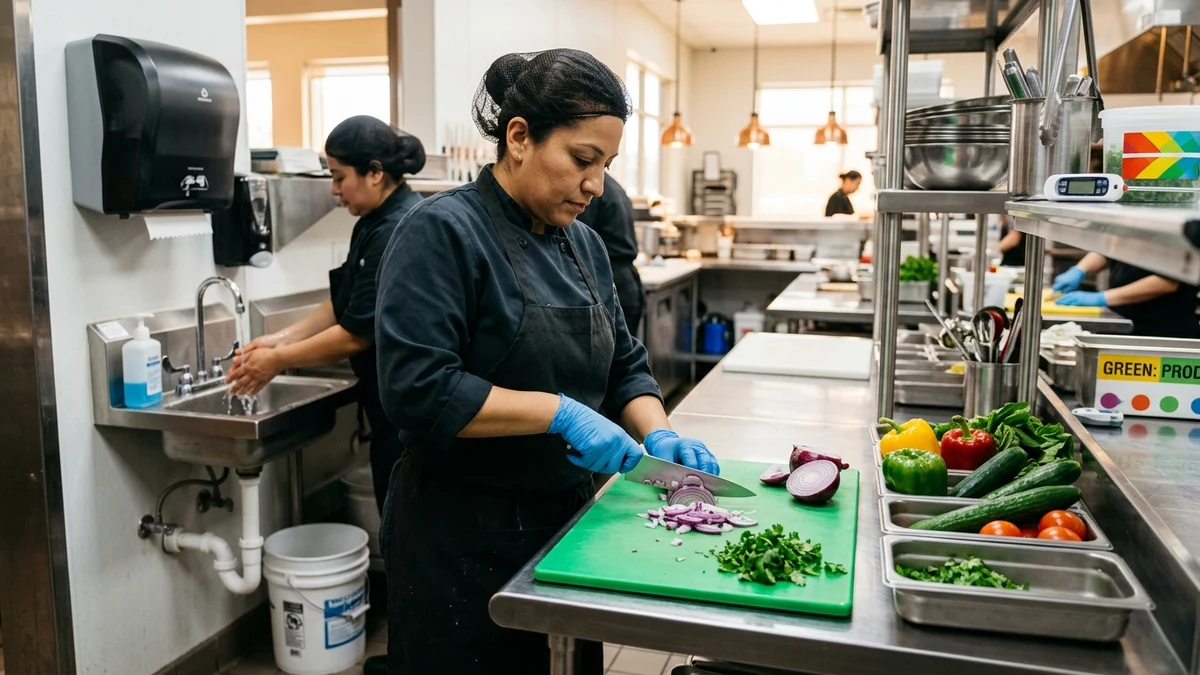
Under FDA Food Code § 2-301.12, proper hand hygiene represents the single most effective barrier against the transfer of norovirus and bacterial pathogens to food and food-contact surfaces (see our 50 most missed ServSafe test questions and answers for common hygiene exam traps). The complete handwashing sequence must take at least 20 seconds: wet hands with clean warm water (at least 100°F / 38°C), apply adequate soap, vigorously rub hands and exposed portions of arms for 10 to 15 seconds (paying particular attention to fingertips, between fingers, and under fingernails), rinse thoroughly under clean running water, and dry completely using a single-use paper towel or warm-air hand dryer. Food handlers should use a clean paper towel to turn off the faucet handles and open restroom doors to prevent immediate recontamination.
Single-use disposable gloves are never a substitute for handwashing. Hands must always be washed before putting on new gloves. In commercial prep environments, gloves must be replaced immediately when torn, punctured, or contaminated, after touching bare human skin, when switching between raw animal proteins and ready-to-eat produce, and after 4 hours of continuous use on the same prep task.
The FDA Food Code establishes strict employee health reporting mandates. Food handlers must immediately report to the Person in Charge if they experience symptoms of vomiting, diarrhea, jaundice (yellow skin or eyes), or sore throat with fever. Workers suffering from vomiting or diarrhea must be excluded from the establishment until they have been completely symptom-free for at least 24 hours without the aid of medication. Diagnoses involving the Big 6 Pathogens (Norovirus, Hepatitis A, Shigella spp., Shiga toxin-producing E. coli, Salmonella Typhi, or Non-typhoidal Salmonella) require mandatory exclusion and formal notification of the local health department. For supervisory staff overseeing these exclusion policies, consult the 90-question ServSafe Manager practice exam. Frontline handlers must also maintain statutory refrigeration thresholds (≤ 41°F) specified in our safe cooking and holding temperatures reference chart. To verify whether your county or state mandates formal food handler certification, consult our 50-state licensing directory.
Career Advancement & Certification Resources
- Return to the master ServSafe exam simulation hub to test your broader knowledge across time-temperature and regulatory questions.
- Prepare for county health department worker permits on our municipal food worker health card exam simulator.
- Advance to supervisory restaurant leadership with our ServSafe manager practice test and study guide.
- Review top missed exam scenarios on our ServSafe practice test with answers and FDA rationales.
- Verify your local state training deadlines and certificate costs in our state food handler card licensing requirements directory.
Frequently Asked Questions About the Food Handlers Card Test
Practical guidance on card validity, testing rules, and hand hygiene compliance.
How many questions are on the ServSafe Food Handler test?
The ServSafe Food Handler assessment consists of 40 multiple-choice questions. Test takers have approximately 60 minutes to complete the test and must score 75% or higher (at least 30 correct answers) to receive their food handler card.
Does this food handling test include a full answer key and printable PDF option?
Yes. Every item in our 40-question practice food handling test provides an instant answer key explanation grounded in the 2022/2026 FDA Food Code, and you can print the complete assessment as a printable PDF study worksheet.
Is 'Safe Serve', 'SafeServe', or 'Server Safe' Food Handler the same exam?
Yes. Whether candidates search for Safe Serve, SafeServe, Server Safe, or a general food handling test, these terms refer to the ANAB-accredited ServSafe Food Handler certificate required by state and county health departments.
Is the ServSafe Food Handler test timed?
Most jurisdictions allow un-timed or 60-minute time limits for the online Food Handler test. Our practice exam includes both a self-paced Study Mode with instant explanations and an optional 60-minute countdown simulator.
How long does a food handler card remain valid?
Under standard ANSI accreditation, food handler certificates remain valid for 3 years from the date of issue. Certain jurisdictions (like California under SB 602, Illinois, and Texas) require renewal every 3 years.