

FoodSafetyPrep.online
FoodSafetyPrep.online ANSI-CFP Practice Standard • 2022 FDA Food Code
50 Curated Questions 2022 FDA Citations SME Verified

ServSafe Questions and Answers (50 Top Missed Exam Questions)

Mastering the ServSafe Food Protection Manager exam requires understanding the exact regulatory logic behind scenario questions. Below is our comprehensive study bank of 50 frequently missed exam questions, organized across all five core testing domains with instant rationales grounded in the 2022 FDA Model Food Code.

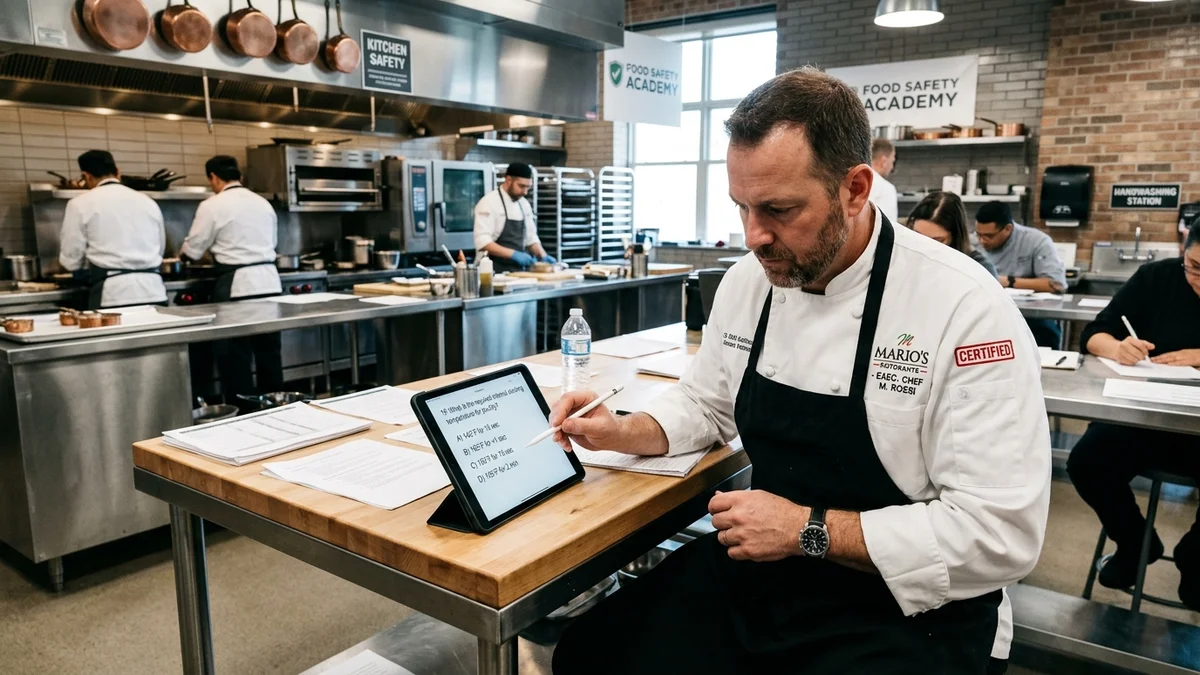
Food safety manager reviewing test questions on clipboard in commercial kitchen setting
AI Visual

50 ServSafe Practice Questions & Detailed Rationale Bank

Showing 50 of 50 Questions
Q1 Time & Temperature (30%) FDA Food Code 2022 § 3-401.11(A)(3)

What is the minimum internal cooking temperature for whole or ground poultry, stuffed pasta, and stuffing containing meat?

A 145°F (63°C) for 15 seconds
B 155°F (68°C) for 17 seconds
C 165°F (74°C) instantaneous (<1 second) ✓ Correct Answer
D 135°F (57°C) for holding
Official FDA Food Code Rationale:

Poultry, stuffing containing fish, meat, or poultry, and stuffed pasta must reach an internal temperature of 165°F (74°C) instantaneously to destroy Salmonella and Campylobacter.

Statutory Reference: FDA Food Code 2022 § 3-401.11(A)(3)
Q2 Time & Temperature (30%) FDA Food Code 2022 § 3-401.11(A)(2)

A cook is preparing ground beef patties for lunch service. What minimum internal temperature must the patties reach, and for how long?

A 145°F (63°C) for 15 seconds
B 155°F (68°C) for 17 seconds ✓ Correct Answer
C 160°F (71°C) for 1 minute
D 165°F (74°C) instantaneous
Official FDA Food Code Rationale:

Comminuted (ground) meats such as ground beef and ground pork must be cooked to 155°F (68°C) for at least 17 seconds to destroy Shiga toxin-producing E. coli.

Statutory Reference: FDA Food Code 2022 § 3-401.11(A)(2)
Q3 Time & Temperature (30%) FDA Food Code 2022 § 3-501.16(A)(2)

What is the maximum allowable cold holding temperature for sliced melons, cut tomatoes, and raw shelled eggs held in a buffet display?

A 38°F (3°C)
B 41°F (5°C) ✓ Correct Answer
C 45°F (7°C)
D 50°F (10°C)
Official FDA Food Code Rationale:

Refrigerated TCS foods must be maintained at 41°F (5°C) or colder at all times to slow bacterial growth of pathogens like Listeria monocytogenes.

Statutory Reference: FDA Food Code 2022 § 3-501.16(A)(2)
Q4 Time & Temperature (30%) FDA Food Code 2022 § 3-501.14(A)(1)

Under the FDA two-stage cooling requirement, cooked chili must be cooled from 135°F to 70°F within what maximum timeframe?

A 1 hour
B 2 hours ✓ Correct Answer
C 3 hours
D 4 hours
Official FDA Food Code Rationale:

In stage one of the two-stage cooling process, cooked food must be cooled from 135°F to 70°F within 2 hours, as bacteria multiply most rapidly between 125°F and 70°F.

Statutory Reference: FDA Food Code 2022 § 3-501.14(A)(1)
Q5 Time & Temperature (30%) FDA Food Code 2022 § 3-501.14

If cooked soup fails to cool from 135°F to 70°F within 2 hours, what corrective action must the manager take?

A Place it in the walk-in freezer immediately
B Reheat it to 165°F for 15 seconds within 2 hours or discard it ✓ Correct Answer
C Add ice cubes and continue the cooling clock
D Cover the pot tightly and transfer to cold storage
Official FDA Food Code Rationale:

If food has not reached 70°F within 2 hours, it must either be reheated to 165°F (74°C) for 15 seconds within 2 hours and restarted in cooling, or completely discarded.

Statutory Reference: FDA Food Code 2022 § 3-501.14
Q6 Time & Temperature (30%) FDA Food Code 2022 § 3-501.14

What is the total maximum allowable time for cooling cooked TCS food from 135°F to 41°F or below?

A 4 hours
B 5 hours
C 6 hours ✓ Correct Answer
D 8 hours
Official FDA Food Code Rationale:

The total allowable cooling duration is 6 hours: 2 hours to cool from 135°F to 70°F, and 4 hours to cool from 70°F to 41°F or below.

Statutory Reference: FDA Food Code 2022 § 3-501.14
Q7 Time & Temperature (30%) FDA Food Code 2022 § 3-403.11

When reheating previously cooked TCS food for hot holding, what internal temperature must it reach, and within what timeframe?

A 145°F (63°C) within 4 hours
B 155°F (68°C) within 1 hour
C 165°F (74°C) for 15 seconds within 2 hours ✓ Correct Answer
D 175°F (79°C) within 3 hours
Official FDA Food Code Rationale:

TCS food that is cooked, cooled, and reheated for hot holding must be rapidly reheated to an internal temperature of 165°F (74°C) for 15 seconds within 2 hours.

Statutory Reference: FDA Food Code 2022 § 3-403.11
Q8 Time & Temperature (30%) FDA Food Code 2022 § 3-501.16(A)(1)

What is the minimum hot holding temperature for beef stew held on a customer buffet line?

A 125°F (52°C)
B 135°F (57°C) ✓ Correct Answer
C 140°F (60°C)
D 150°F (66°C)
Official FDA Food Code Rationale:

Hot TCS foods must be held at 135°F (57°C) or higher to prevent spores of Clostridium perfringens and Bacillus cereus from germinating and producing toxins.

Statutory Reference: FDA Food Code 2022 § 3-501.16(A)(1)
Q9 Time & Temperature (30%) FDA Food Code 2022 § 3-401.11(A)(1)(a)

What is the minimum internal cooking temperature for commercially raised game animals, intact steaks of beef, and pork chops?

A 135°F (57°C) for 1 minute
B 145°F (63°C) for 15 seconds ✓ Correct Answer
C 155°F (68°C) for 17 seconds
D 165°F (74°C) instantaneous
Official FDA Food Code Rationale:

Intact steaks, pork chops, and commercially raised game require cooking to 145°F (63°C) for at least 15 seconds.

Statutory Reference: FDA Food Code 2022 § 3-401.11(A)(1)(a)
Q10 Time & Temperature (30%) FDA Food Code 2022 § 3-401.12

When cooking food in a microwave oven, what procedure is mandated by the 2022 FDA Food Code?

A Cook uncovered on high power for 3 minutes
B Rotate or stir midway, cover, heat to 165°F (74°C), and let stand covered for 2 minutes ✓ Correct Answer
C Heat to 155°F and serve immediately
D Use only glass cookware and cook for 5 minutes continuous
Official FDA Food Code Rationale:

Raw animal foods cooked in a microwave must be rotated or stirred, covered, heated to at least 165°F (74°C) in all parts, and allowed to stand covered for 2 minutes to equalize temperature.

Statutory Reference: FDA Food Code 2022 § 3-401.12
Q11 Time & Temperature (30%) FDA Food Code 2022 § 3-501.17(A)

How long can ready-to-eat TCS food prepared on-site be stored in a refrigerator at 41°F (5°C) or lower before it must be discarded?

A 3 days
B 5 days
C 7 days ✓ Correct Answer
D 10 days
Official FDA Food Code Rationale:

Ready-to-eat TCS food may be held at 41°F (5°C) or lower for a maximum of 7 days, with day of preparation counting as Day 1.

Statutory Reference: FDA Food Code 2022 § 3-501.17(A)
Q12 Time & Temperature (30%) FDA Food Code 2022 § 3-501.13

Which of the following is an unacceptable method for thawing frozen raw turkey breasts?

A In a refrigerator at 41°F (5°C) or below
B Submerged under running potable water at 70°F (21°C) or below
C On a stainless steel prep counter at room temperature ✓ Correct Answer
D In a microwave oven as part of an uninterrupted continuous cooking process
Official FDA Food Code Rationale:

Thawing at room temperature allows the outer surface of the food to enter the Temperature Danger Zone (41°F-135°F) for extended hours while the interior remains frozen.

Statutory Reference: FDA Food Code 2022 § 3-501.13
Q13 Time & Temperature (30%) FDA Food Code 2022 § 3-501.16

What is the Temperature Danger Zone where pathogenic foodborne bacteria reproduce most rapidly?

A 32°F to 100°F (0°C to 38°C)
B 41°F to 135°F (5°C to 57°C) ✓ Correct Answer
C 50°F to 140°F (10°C to 60°C)
D 60°F to 165°F (16°C to 74°C)
Official FDA Food Code Rationale:

The Temperature Danger Zone is 41°F to 135°F (5°C to 57°C), with the most rapid bacterial growth occurring between 70°F and 125°F.

Statutory Reference: FDA Food Code 2022 § 3-501.16
Q14 Time & Temperature (30%) FDA Food Code 2022 § 3-501.19(B)

If cold food is removed from refrigeration without temperature control, what is the maximum time it may be served, provided it never exceeds 70°F (21°C)?

A 2 hours
B 4 hours
C 6 hours ✓ Correct Answer
D 8 hours
Official FDA Food Code Rationale:

Cold food may be held without temperature control for up to 6 hours if it is held at 41°F or below before removal and does not exceed 70°F during the 6-hour period.

Statutory Reference: FDA Food Code 2022 § 3-501.19(B)
Q15 Time & Temperature (30%) FDA Food Code 2022 § 3-501.19(A)

If hot food is removed from temperature control, what is the maximum duration it can be held before it must be served or discarded?

A 2 hours
B 4 hours ✓ Correct Answer
C 6 hours
D 8 hours
Official FDA Food Code Rationale:

Hot food can be held without temperature control for a maximum of 4 hours, provided it was held at 135°F or above prior to removal.

Statutory Reference: FDA Food Code 2022 § 3-501.19(A)
Q16 Time & Temperature (30%) FDA Food Code 2022 § 3-401.11(B)

What is the minimum internal cooking temperature for whole beef roasts when cooked in a conventional oven?

A 130°F (54°C) for 112 minutes or 145°F (63°C) for 4 minutes ✓ Correct Answer
B 155°F (68°C) for 15 seconds
C 165°F (74°C) for 1 minute
D 175°F (79°C) instantaneous
Official FDA Food Code Rationale:

Whole roasts may be cooked according to alternative time-temperature schedules, including 130°F for 112 minutes or 145°F for 4 minutes.

Statutory Reference: FDA Food Code 2022 § 3-401.11(B)
Q17 Time & Temperature (30%) FDA Food Code 2022 § 4-302.12

Which thermometer probe is best suited for measuring the temperature of thin hamburger patties or fish fillets?

A Bimetallic stemmed dial thermometer
B Immersion probe
C Thermocouple with a penetration or needle probe ✓ Correct Answer
D Air probe
Official FDA Food Code Rationale:

Thermocouples with small-diameter needle probes accurately measure the core temperature of thin food items without requiring deep immersion.

Statutory Reference: FDA Food Code 2022 § 4-302.12
Q18 Time & Temperature (30%) FDA Food Code 2022 § 4-502.11

When calibrating a bimetallic stemmed thermometer using the ice-point method, what temperature should the indicator read when submerged in ice slurry?

A 0°F (-18°C)
B 32°F (0°C) ✓ Correct Answer
C 38°F (3°C)
D 41°F (5°C)
Official FDA Food Code Rationale:

The ice-point calibration method requires immersing the sensing area into a 50/50 crushed ice and cold water slurry until steady at 32°F (0°C).

Statutory Reference: FDA Food Code 2022 § 4-502.11
Q19 Time & Temperature (30%) FDA Food Code 2022 § 4-203.11

What accuracy tolerance is required for temperature measuring devices used to monitor food temperatures?

A ±1°F (±0.5°C)
B ±2°F (±1°C) ✓ Correct Answer
C ±3°F (±1.5°C)
D ±5°F (±2.5°C)
Official FDA Food Code Rationale:

Food temperature measuring devices must be accurate to within ±2°F (±1°C) across their intended operating range.

Statutory Reference: FDA Food Code 2022 § 4-203.11
Q20 Time & Temperature (30%) FDA Food Code 2022 § 3-401.11(C)

What is the minimum temperature for plant food (grains, legumes, vegetables) cooked for hot holding?

A 125°F (52°C)
B 135°F (57°C) ✓ Correct Answer
C 145°F (63°C)
D 155°F (68°C)
Official FDA Food Code Rationale:

Fruits, vegetables, and grains cooked for hot holding must reach a minimum internal temperature of 135°F (57°C).

Statutory Reference: FDA Food Code 2022 § 3-401.11(C)
Q21 Personal Hygiene (15%) FDA Food Code 2022 § 2-301.12

According to the FDA Food Code, what is the minimum duration for the entire handwashing process, and how long must vigorous scrubbing last?

A 10 seconds total; 5 seconds scrubbing
B 20 seconds total; 10 to 15 seconds vigorous scrubbing with soap ✓ Correct Answer
C 30 seconds total; 20 seconds scrubbing
D 1 minute total; 30 seconds scrubbing
Official FDA Food Code Rationale:

The complete handwashing cycle must take at least 20 seconds, including at least 10 to 15 seconds of vigorous scrubbing with soap and warm water (≥100°F).

Statutory Reference: FDA Food Code 2022 § 2-301.12
Q22 Personal Hygiene (15%) FDA Food Code 2022 § 2-201.12(B)

A food handler diagnosed with Norovirus must be subjected to which administrative action by the Person in Charge?

A Restricted from handling ready-to-eat food only
B Excluded completely from the food establishment ✓ Correct Answer
C Allowed to work if wearing double gloves
D Assigned only to dishwashing and garbage duties
Official FDA Food Code Rationale:

Workers diagnosed with Norovirus, Hepatitis A, Shigella, STEC, Salmonella Typhi, or Non-typhoidal Salmonella must be completely excluded from the facility.

Statutory Reference: FDA Food Code 2022 § 2-201.12(B)
Q23 Personal Hygiene (15%) FDA Food Code 2022 § 2-201.12(H)

Under what condition must a food worker with a sore throat and fever be EXCLUDED rather than merely restricted?

A If the establishment serves a high-risk population (e.g., nursing home, hospital, day care) ✓ Correct Answer
B If the worker has worked more than 40 hours this week
C If the worker does not have health insurance
D If the restaurant is open on a weekend
Official FDA Food Code Rationale:

A worker with sore throat and fever is restricted in normal restaurants, but must be completely EXCLUDED if the facility primarily serves a highly susceptible population.

Statutory Reference: FDA Food Code 2022 § 2-201.12(H)
Q24 Personal Hygiene (15%) FDA Food Code 2022 § 2-303.11

Which piece of jewelry is the ONLY item permitted on food workers hands or arms while preparing food?

A A medical alert silicone band
B A plain smooth wedding band ✓ Correct Answer
C A diamond solitaire ring with gloves
D A stainless steel wristwatch
Official FDA Food Code Rationale:

Food handlers may wear only a single plain ring, such as a smooth wedding band, with no gemstones or engravings that could harbor pathogens or dislodge.

Statutory Reference: FDA Food Code 2022 § 2-303.11
Q25 Personal Hygiene (15%) FDA Food Code 2022 § 3-301.11(B)

When is bare-hand contact with ready-to-eat (RTE) foods legally permitted in a standard food establishment?

A Whenever the worker washed their hands within the last 15 minutes
B Never, unless the establishment has received a regulatory variance with an approved prior bare-hand contact plan ✓ Correct Answer
C Whenever gloves run out in inventory
D When handling bread or sandwich rolls
Official FDA Food Code Rationale:

Bare-hand contact with ready-to-eat food is strictly prohibited unless the regulatory authority has granted a specific written variance with extensive employee health and verification procedures.

Statutory Reference: FDA Food Code 2022 § 3-301.11(B)
Q26 Personal Hygiene (15%) FDA Food Code 2022 § 5-202.12

What is the minimum temperature for water at a dedicated employee handwashing sink?

A 70°F (21°C)
B 85°F (29°C)
C 100°F (38°C) ✓ Correct Answer
D 120°F (49°C)
Official FDA Food Code Rationale:

A handwashing sink must be equipped to provide potable water through a mixing valve or combination faucet at a temperature of at least 100°F (38°C).

Statutory Reference: FDA Food Code 2022 § 5-202.12
Q27 Personal Hygiene (15%) FDA Food Code 2022 § 2-401.15

A food handler has an infected wound on their index finger. How must the wound be protected before the handler can work with food?

A Covered with a dry sterile bandage only
B Covered with an impermeable bandage (such as a finger cot) AND a single-use disposable glove ✓ Correct Answer
C Covered with liquid antiseptic spray and no bandage
D Covered with clear tape
Official FDA Food Code Rationale:

Lesions and wounds on hands or wrists must be covered with an impermeable cover (bandage/finger cot) plus a single-use glove worn over the cover.

Statutory Reference: FDA Food Code 2022 § 2-401.15
Q28 Personal Hygiene (15%) FDA Food Code 2022 § 2-201.12(A)

Which symptom mandates immediate employee exclusion from a commercial kitchen?

A Headache
B Vomiting or diarrhea ✓ Correct Answer
C Mild fatigue
D Seasonal allergies with sneezing into a tissue
Official FDA Food Code Rationale:

Vomiting and diarrhea are primary symptoms of acute foodborne illnesses requiring immediate exclusion from the facility until symptom-free for at least 24 to 48 hours.

Statutory Reference: FDA Food Code 2022 § 2-201.12(A)
Q29 Cross-Contamination (25%) FASTER Act of 2021 / FDA § 1-201.10(B)

What are the Big 9 major food allergens identified by federal statute requiring strict cross-contact prevention?

A Milk, Eggs, Fish, Crustacean Shellfish, Tree Nuts, Peanuts, Wheat, Soybeans, Sesame ✓ Correct Answer
B Corn, Beef, Pork, Gluten, Strawberries, Peanuts, Milk, Eggs, Soy
C Tomatoes, Onions, Garlic, Shellfish, Tree Nuts, Peanuts, Wheat, Dairy, Eggs
D Pork, Shellfish, MSG, Sulfites, Gluten, Dairy, Soy, Peanuts, Sesame
Official FDA Food Code Rationale:

The 9 major food allergens under federal law are Milk, Eggs, Fish, Crustacean Shellfish, Tree Nuts, Peanuts, Wheat, Soybeans, and Sesame.

Statutory Reference: FASTER Act of 2021 / FDA § 1-201.10(B)
Q30 Cross-Contamination (25%) FDA Food Code 2022 § 3-302.11

What is the crucial difference between cross-contamination and allergen cross-contact?

A Cross-contamination involves bacteria destroyed by cooking; cross-contact transfers allergen proteins that CANNOT be eliminated by cooking ✓ Correct Answer
B Cross-contact only occurs with raw meat; cross-contamination occurs with dairy
C Cross-contamination requires sanitizing; cross-contact requires boiling water
D There is no difference; the terms are legally interchangeable
Official FDA Food Code Rationale:

Cross-contamination refers to microorganisms transferred between foods (which cooking can destroy), whereas cross-contact transfers allergenic proteins that heat and cooking CANNOT remove.

Statutory Reference: FDA Food Code 2022 § 3-302.11
Q31 Cross-Contamination (25%) FDA Food Code 2022 § 3-302.11(A)(1)

To prevent cross-contamination, how must raw animal foods be stored relative to ready-to-eat foods in a refrigerated unit?

A Raw animal foods must always be stored ABOVE ready-to-eat foods to keep them colder
B Raw animal foods must be stored BELOW ready-to-eat foods to prevent juices from dripping onto cooked or ready-to-eat items ✓ Correct Answer
C They can be stored side-by-side on the same shelf if wrapped in plastic
D Poultry should be stored on the top shelf because it cooks to the highest temperature
Official FDA Food Code Rationale:

Raw animal foods must be placed beneath ready-to-eat foods to prevent juices containing pathogens from dripping onto foods that will receive no further cooking.

Statutory Reference: FDA Food Code 2022 § 3-302.11(A)(1)
Q32 Cross-Contamination (25%) FDA Food Code 2022 § 3-302.11

A cook uses a cutting board to slice raw chicken breasts and then immediately prepares raw romaine lettuce for a Caesar salad. What food safety violation has occurred?

A Physical hazard introduction
B Biological cross-contamination ✓ Correct Answer
C Chemical hazard contamination
D Time-temperature abuse
Official FDA Food Code Rationale:

Using contaminated cutting surfaces transfers live pathogens (Salmonella, Campylobacter) from raw poultry directly to ready-to-eat lettuce, creating an acute outbreak hazard.

Statutory Reference: FDA Food Code 2022 § 3-302.11
Q33 Cross-Contamination (25%) FDA Food Code 2022 § 4-101.14 / § 4-101.15

Which equipment material is prohibited for storing acidic foods such as tomato sauce, citrus juice, or vinegar dressings?

A Food-grade 304 stainless steel
B Food-grade polyethylene plastic
C Copper, brass, and galvanized metal ✓ Correct Answer
D Tempered NSF glass containers
Official FDA Food Code Rationale:

Copper, zinc (galvanized metal), brass, and pewter leach toxic heavy metals into acidic foods (pH <6.0), causing acute heavy metal chemical poisoning.

Statutory Reference: FDA Food Code 2022 § 4-101.14 / § 4-101.15
Q34 Cleaning & Sanitizing (15%) FDA Food Code 2022 § 4-501.114

In a three-compartment sink setup, what are the three mandatory operations in sequence from left to right?

A Sanitize, Rinse, Wash
B Wash (≥110°F with detergent), Clean Water Rinse, Sanitize (chemical or ≥171°F hot water), followed by Air Drying ✓ Correct Answer
C Soak in bleach, Soap Wash, Towel Dry
D Scrape, Towel Dry, Heat Sanitize
Official FDA Food Code Rationale:

The three-compartment sink sequence is Wash (detergent at ≥110°F), Rinse (clean warm water), and Sanitize (chemical solution or ≥171°F hot water for 30s), followed strictly by air drying.

Statutory Reference: FDA Food Code 2022 § 4-501.114
Q35 Cleaning & Sanitizing (15%) FDA Food Code 2022 § 4-501.114(A)

What is the required concentration of chlorine sanitizer in a manual three-compartment sink for general food-contact sanitization?

A 10 to 25 ppm
B 50 to 99 ppm (or up to 100 ppm per label) ✓ Correct Answer
C 200 to 400 ppm
D 500 to 1000 ppm
Official FDA Food Code Rationale:

Chlorine sanitizing solutions must have a minimum concentration of 50 ppm (up to 100 ppm) with appropriate water temperature (≥75°F or ≥100°F depending on pH).

Statutory Reference: FDA Food Code 2022 § 4-501.114(A)
Q36 Cleaning & Sanitizing (15%) FDA Food Code 2022 § 4-901.11

How should sanitized pots, pans, and tableware be dried after passing through a sanitizer rinse?

A Wiped dry with clean cotton bar towels
B Air-dried on clean, non-absorbent, draining racks ✓ Correct Answer
C Blown dry with a commercial hair dryer
D Stacked immediately while wet in enclosed cupboards
Official FDA Food Code Rationale:

All equipment and utensils must be AIR-DRIED before storage or use. Towel drying reintroduces pathogens and lint from contaminated cloths.

Statutory Reference: FDA Food Code 2022 § 4-901.11
Q37 Cleaning & Sanitizing (15%) FDA Food Code 2022 § 4-501.19

What minimum water temperature must be maintained in the wash compartment of a manual three-compartment warewashing sink?

A 85°F (29°C)
B 100°F (38°C)
C 110°F (43°C) ✓ Correct Answer
D 140°F (60°C)
Official FDA Food Code Rationale:

The wash compartment containing detergent solution must be maintained at a temperature not less than 110°F (43°C) to effectively dissolve grease and food residues.

Statutory Reference: FDA Food Code 2022 § 4-501.19
Q38 Cleaning & Sanitizing (15%) FDA Food Code 2022 § 4-501.111(A)

If sanitizing utensils using hot water immersion in a manual three-compartment sink, what minimum temperature and immersion time are required?

A 150°F (66°C) for 1 minute
B 165°F (74°C) for 45 seconds
C 171°F (77°C) for at least 30 seconds ✓ Correct Answer
D 180°F (82°C) for 10 seconds
Official FDA Food Code Rationale:

Hot water immersion sanitization in a manual sink requires water at or above 171°F (77°C) with the item completely submerged for at least 30 seconds.

Statutory Reference: FDA Food Code 2022 § 4-501.111(A)
Q39 Cleaning & Sanitizing (15%) FDA Food Code 2022 § 4-302.14

What tool must be readily available at warewashing stations to verify chemical sanitizer concentration?

A A digital bimetallic thermometer
B An appropriate chemical test kit or test strips calibrated for the specific sanitizer chemical in use ✓ Correct Answer
C A pH litmus paper book
D An electronic TDS meter
Official FDA Food Code Rationale:

A test kit or other device that accurately measures concentration in ppm (parts per million) must be provided to verify that sanitizing solutions meet statutory strength.

Statutory Reference: FDA Food Code 2022 § 4-302.14
Q40 Cleaning & Sanitizing (15%) FDA Food Code 2022 § 4-605.11(A)

How frequently must food-contact surfaces in continuous use with TCS foods at room temperature (e.g. deli slicers) be cleaned and sanitized?

A Every 2 hours
B Every 4 hours ✓ Correct Answer
C Every 8 hours
D At the end of each business day
Official FDA Food Code Rationale:

Equipment and utensils in continuous contact with TCS food held at room temperature must be disassembled, cleaned, and sanitized at least every 4 hours.

Statutory Reference: FDA Food Code 2022 § 4-605.11(A)
Q41 Food Safety & HACCP (15%) FDA Food Code 2022 § 8-201.14 / HACCP Guidelines

What is the first of the 7 core principles of a Hazard Analysis Critical Control Point (HACCP) system?

A Determine critical control points (CCPs)
B Establish critical limits
C Conduct a hazard analysis ✓ Correct Answer
D Establish monitoring procedures
Official FDA Food Code Rationale:

Principle 1 of HACCP is to conduct a hazard analysis by evaluating the menu to identify biological, chemical, or physical hazards associated with each process step.

Statutory Reference: FDA Food Code 2022 § 8-201.14 / HACCP Guidelines
Q42 Food Safety & HACCP (15%) FDA Food Code 2022 § 3-502.11

Which operational process strictly requires an approved regulatory variance AND a formal HACCP plan under the FDA Food Code?

A Baking fresh French bread from flour and yeast
B Smoking meat as a method of food preservation or curing food ✓ Correct Answer
C Boiling pasta in a commercial steam cooker
D Grilling steaks on an outdoor charcoal grill
Official FDA Food Code Rationale:

Curing food, smoking food for preservation, operating molluscan shellfish display tanks, custom processing animals, and reduced-oxygen packaging (ROP) require a formal regulatory variance and HACCP plan.

Statutory Reference: FDA Food Code 2022 § 3-502.11
Q43 Food Safety & HACCP (15%) FDA Food Code 2022 § 1-201.10(B)

In a HACCP plan, what is a "Critical Limit"?

A The maximum price paid for raw ingredients
B A maximum and/or minimum boundary of a physical or biological parameter that must be controlled to prevent, eliminate, or reduce a hazard ✓ Correct Answer
C The maximum number of customers served per hour
D The expiration date stamped on packaged dry spices
Official FDA Food Code Rationale:

A critical limit is a measurable criterion (e.g. 165°F internal temperature for 15 seconds) that separates safe acceptable operations from unsafe unacceptable conditions at a CCP.

Statutory Reference: FDA Food Code 2022 § 1-201.10(B)
Q44 Food Safety & HACCP (15%) ServSafe / Conference for Food Protection Standard

What is the official minimum passing score required on the ServSafe Food Protection Manager Certification Examination?

A 65%
B 70%
C 75% ✓ Correct Answer
D 80%
Official FDA Food Code Rationale:

Under ANSI-CFP accreditation standards, candidates must achieve a minimum scaled score of 75% (at least 60 correct answers out of 80 scored questions).

Statutory Reference: ServSafe / Conference for Food Protection Standard
Q45 Food Safety & HACCP (15%) FDA Food Code 2022 § 8-404.11

What is an imminent health hazard that mandates immediate voluntary closure of a commercial food establishment?

A A non-functioning prep table reach-in thermometer
B A complete extended disruption of electrical power, lack of potable running water, or catastrophic sewage backup ✓ Correct Answer
C A broken ice scoop handle
D A single food handler with an uncovered wrist tattoo
Official FDA Food Code Rationale:

Sewage backups, extended power outages, loss of potable water supply, and structural fires represent imminent health hazards requiring immediate cessation of operations.

Statutory Reference: FDA Food Code 2022 § 8-404.11
Q46 Food Safety & HACCP (15%) FDA Food Code 2022 § 8-402.11

According to the FDA Food Code, what authority does a municipal health department regulatory inspector possess during a routine inspection?

A Must make an appointment 24 hours in advance
B Has the right to enter and inspect all areas of the food establishment during operational hours upon presenting official credentials ✓ Correct Answer
C Can only inspect dining areas open to public view
D Must have a signed search warrant from a county judge
Official FDA Food Code Rationale:

Health inspectors presenting official credentials must be allowed immediate access to all food storage, preparation, warewashing, and waste handling areas during business hours.

Statutory Reference: FDA Food Code 2022 § 8-402.11
Q47 Food Safety & HACCP (15%) FDA Food Code 2022 § 2-101.11 / § 2-102.11

What is the role of the designated Person in Charge (PIC) under the 2022 FDA Food Code?

A Only responsible for bookkeeping and payroll
B Must be present on the premises during all operational hours and demonstrate active managerial control over food safety practices ✓ Correct Answer
C May designate an untrained teenage dishwasher as PIC when stepping out for lunch
D Required only during local health department inspections
Official FDA Food Code Rationale:

A designated Person in Charge possessing certified food safety knowledge must be physically present on site during all operating hours to enforce statutory hygiene and food safety rules.

Statutory Reference: FDA Food Code 2022 § 2-101.11 / § 2-102.11
Q48 Food Safety & HACCP (15%) FDA Bad Bug Book / FDA § 3-502.12

Which pathogen produces a potent neurotoxin in improperly canned foods, vacuum-packed garlic oil, and baked potatoes held in foil at room temperature?

A Clostridium botulinum ✓ Correct Answer
B Salmonella enterica
C Norovirus
D Staphylococcus aureus
Official FDA Food Code Rationale:

Clostridium botulinum is an anaerobic spore-former that produces deadly neurotoxins in low-oxygen, low-acid environments (canned goods, vacuum-sealed bags, foil-wrapped potatoes at room temp).

Statutory Reference: FDA Bad Bug Book / FDA § 3-502.12
Q49 Food Safety & HACCP (15%) CDC / FDA Food Code 2022 Annex 3

What is the leading cause of non-bacterial, viral foodborne gastroenteritis outbreaks in restaurants and cruise ships?

A Rotavirus
B Norovirus ✓ Correct Answer
C Hepatitis B
D Influenza A
Official FDA Food Code Rationale:

Norovirus is the number one cause of foodborne illness in the United States, characterized by high contagiousness and transmission via infected food worker hands.

Statutory Reference: CDC / FDA Food Code 2022 Annex 3
Q50 Food Safety & HACCP (15%) FDA § 3-202.15

[50] What should be done with a dented can of green beans with swollen ends discovered during receiving?

A Cook immediately to 165°F
B Reject or segregate and label do not use, then return to supplier ✓ Correct Answer
C Place in walk-in cooler
D Wipe with sanitizer and shelf
Official FDA Food Code Rationale:

Swollen or severely dented cans may contain Clostridium botulinum neurotoxin and must be rejected immediately.

Statutory Reference: FDA § 3-202.15
ANSI-CFP Standards Conference for Food Protection Aligned
2022 FDA Model Food Code Statutory Rationale Citations
Instant Diagnostic Scoring 75% Passing Boundary Telemetry
ANAB Accredited Model Zero Paywalls • No Registration Required
Position #0 Direct Answer

What is on the ServSafe Food Protection Manager Exam?

The ServSafe Food Protection Manager Exam consists of 90 multiple-choice questions administered over a 2-hour (120-minute) testing window. Only 80 questions are scored (10 are experimental research items). To pass, candidates must attain a scaled score of 75% (correctly answering at least 68 of 90 questions). Testing covers 5 primary domains: Time & Temperature Control (30%), Cross-Contamination & Allergens (25%), Personal Hygiene (15%), Cleaning & Sanitizing (15%), and Regulatory & HACCP (15%).

5 Core Food Safety Testing Domains & Question Weights

30% of Exam

Time & Temperature Control

Safe cooking limits (165°F, 155°F, 145°F, 135°F), danger zone rules, and two-stage cooling.

25% of Exam

Cross-Contamination & Allergens

Walk-in cooler shelf hierarchy, bare-hand contact restrictions, and Big 9 allergen cross-contact.

15% of Exam

Personal Hygiene & Health

20-second handwashing mandates, glove replacement rules, and Big 6 employee illness exclusions.

15% of Exam

Cleaning & Sanitizing

Three-compartment sink setup, chlorine vs quats ppm concentrations, and contact times.

15% of Exam

HACCP Systems & Law

The 7 HACCP principles, Critical Control Points, regulatory variances, and health inspections.

Top 5 Traps on the ServSafe Food Protection Manager Exam

Analysis of candidate score reports reveals that examinees rarely fail due to lack of effort; they fail due to subtle regulatory distinctions in scenario wording. Here are the five most hazardous traps to avoid on test day:

TRAP 01

Exclusion vs. Restriction Nuances

Food handlers with sore throat and fever in a standard restaurant must be restricted from working with exposed food. However, if the operation serves a Highly Susceptible Population (HSP) such as a nursing home or day care, that same employee must be excluded entirely from the premises under § 2-201.12.

TRAP 02

Two-Stage Cooling Timeline Math

You have 2 hours to cool from 135°F to 70°F, and 4 hours to cool from 70°F to 41°F. If you reach 70°F in 1 hour, you can take up to 5 hours for Stage 2 (total 6 hours). But if you take 2.5 hours to reach 70°F, you have failed the critical control point and must reheat to 165°F or discard immediately.

TRAP 03

Sanitizer Contact Time Discrepancies

Chlorine bleach sanitizers require a minimum of only 7 seconds of contact time at ≥75°F. In contrast, Quaternary Ammonium (Quats) and Iodine solutions both mandate a minimum of 30 seconds of immersion contact time. Selecting 30 seconds for chlorine is an automatic point loss.

TRAP 04

Ground Meat vs. Poultry Internal Temps

Ground beef and ground pork require 155°F (68°C) for 17 seconds. Ground chicken, ground turkey, or any ground poultry requires 165°F (74°C) instantaneous. The rule of thumb: Any dish with poultry in any form must reach 165°F.

TRAP 05

Bare-Hand Contact Exemptions

Bare-hand contact with ready-to-eat (RTE) food is prohibited unless the operation has prior written regulatory approval with documentation of active manager monitoring, two-stage handwashing, and strict employee illness logs. Never assume bare hand contact is permissible for garnishes or sushi without written authorization.

Critical Food Safety Protocol

Big 9 Food Allergen Cross-Contact Decision Matrix

FDA Food Code § 1-201.10 & FASTER Act

Under the FASTER Act and 2022 FDA Model Food Code, commercial food operations must recognize the Big 9 Food Allergens (including Sesame, effective 2023). Heat and cooking oil never destroy allergenic proteins; strict isolation and physical barriers are mandatory to prevent life-threatening anaphylaxis.

FASTER Act 2023 Statutory Addition

Sesame Allergen Management Protocol (§ 1-201.10)

Hidden Commercial Foodservice Vectors:

Tahini paste, hummus, hamburger bun seeds, salad dressings, Asian marinades, falafel, crackers, and dipping sauces. Microscopic seed proteins resist wiping.

Mandatory Kitchen Isolation & Prep Rules:

Requires dedicated purple allergen cutting board and fresh sanitized utensils. Bag and isolate seeded buns away from plain bakery stock. Thoroughly wipe down conveyor toasters.

The "Hot Cooking Oil" Myth: ServSafe Exam Critical Trap

Cooking oil at 350°F (177°C) DOES NOT denature or destroy allergenic proteins. Frying french fries in the same oil previously used to fry breaded shrimp, battered chicken, or gluten tenders results in direct cross-contact transfer. Always inform guests with food allergies that shared fryers cannot provide allergen-safe food.

Frequently Asked Questions About ServSafe Questions &amp; Answers

Practical guidance on exam scoring, question difficulty, and study strategy.

01 How many questions are on the ServSafe Food Protection Manager exam?

The ServSafe Food Protection Manager exam contains 90 multiple-choice questions. 80 questions are officially scored, while 10 are unscored pilot questions. Candidates must answer at least 68 questions (75%) correctly within the 120-minute testing session.

02 What score is required to pass the ServSafe Manager certification?

A minimum scaled score of 75% is required to earn the ServSafe Food Protection Manager certification. This credential is accredited under the ANSI-CFP (Conference for Food Protection) standards and is valid for five years nationwide.

03 What are the most common questions missed on the ServSafe exam?

The most frequently failed topics include the two-stage cooling time-temperature requirements (135°F to 70°F in 2 hours), distinguishing between worker exclusion vs. restriction for Big 6 pathogens, chemical sanitizer contact times (7s for chlorine vs 30s for quats), and refrigerator vertical shelf storage hierarchy.

04 Can I retake the ServSafe exam if I fail on my first attempt?

Yes. If you do not achieve a 75% score, you may retake the exam after a mandatory 24-hour waiting period. If you fail a second time, ServSafe policies require a 60-day waiting period between subsequent attempts, with a maximum of 4 examination attempts in any 12-month calendar window.

05 Are the questions based on the 2022 FDA Model Food Code?

Yes. All current official ServSafe examinations align with the 2022 FDA Food Code, which incorporates sesame as the 9th major food allergen, revised food handler illness reporting requirements, and updated bare-hand contact guidelines.